Wake Up and Breakfast
4:30 AM
Once again, despite the copious amount of drugs they have me on including 2 Tramadol, Vistaril, Gabapentin and Valium before bedtime, I had trouble going to sleep, staying asleep, and was wide awake at just after 4am. I went down stairs for some coffee but didn’t feel like eating anything.
Morning Reflections
8:00 AM
This morning we did the 3 G’s exercise followed by group discussions.
3 G’s:
- 3 things you are grateful for.
- 3 personal growths.
- 3 small goals for today.
Yoga
9:00 AM
Second time doing yoga. I am actually enjoying it and the instructor is great at adding modifications for people like me that are not flexable.

Therapy with Dr. B
10:00 AM
I meet Dr. B for the first time today. She is using the Internal Family Systems (IFS) therapy method with me. It is a transformative, evidence-based approach to psychotherapy that views the mind not as a single entity, but as a “family” of distinct sub-personalities or “parts.”
Developed by Dr. Richard Schwartz in the 1980s, it suggests that everyone possesses an undamaged Self at their core, which has the capacity to lead and heal these internal parts.
The Core Concept: The “Parts”
In IFS, parts are like internal characters that have developed roles to help you navigate life. They generally fall into three categories:
Managers: These are proactive parts that run your daily life. They try to keep you in control, productive, and safe from emotional pain (e.g., the inner critic, the perfectionist, or the planner).
Exiles: These are the “wounded” parts—that carry trauma, shame, or fear. Managers try to keep these exiles locked away so you don’t feel their pain.
Firefighters: These are reactive parts that swoop in when an “Exile” is triggered. Their job is to extinguish emotional pain by any means necessary, often through impulsive behaviors like binge eating, substance use, or outbursts of anger.

Principles of Recovery
11:00 AM
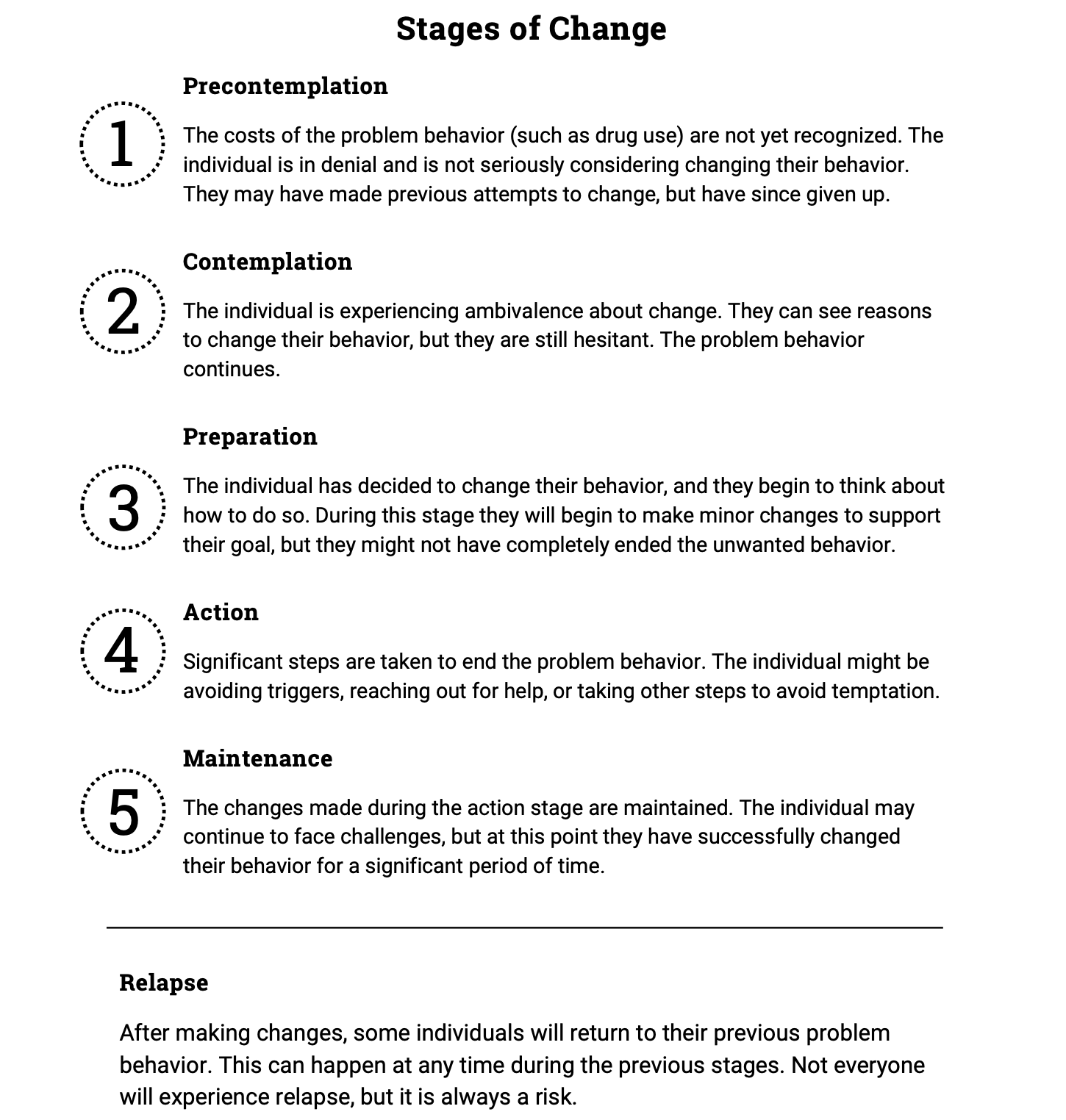
This discussion was all about the stages of relapse using the portion of the article listed below by Dr. Steven M. Melemis. Focused on the stages of relapse section of the article.
We talked about how sometimes relapse is part of the recovery process and you can learn from them and change the process.
Full Article: Relapse Prevention and the Five Rules of Recovery
The Stages of Relapse
The key to relapse prevention is to understand that relapse happens gradually [6]. It begins weeks and sometime months before an individual picks up a drink or drug. The goal of treatment is to help individuals recognize the early warning signs of relapse and to develop coping skills to prevent relapse early in the process, when the chances of success are greatest. This has been shown to significantly reduce the risk of relapse [7]. Gorski has broken relapse into 11 phases [6]. This level of detail is helpful to clinicians but can sometimes be overwhelming to clients. I have found it helpful to think in terms of three stages of relapse: emotional, mental, and physical [4].
Emotional Relapse
During emotional relapse, individuals are not thinking about using. They remember their last relapse and they don’t want to repeat it. But their emotions and behaviors are setting them up for relapse down the road. Because clients are not consciously thinking about using during this stage, denial is a big part of emotional relapse.
These are some of the signs of emotional relapse [1]: 1) bottling up emotions; 2) isolating; 3) not going to meetings; 4) going to meetings but not sharing; 5) focusing on others (focusing on other people’s problems or focusing on how other people affect them); and 6) poor eating and sleeping habits. The common denominator of emotional relapse is poor self-care, in which self-care is broadly defined to include emotional, psychological, and physical care.
One of the main goals of therapy at this stage is to help clients understand what self-care means and why it is important [4]. The need for self-care varies from person to person. A simple reminder of poor self-care is the acronym HALT: hungry, angry, lonely, and tired. For some individuals, self-care is as basic as physical self-care, such as sleep, hygiene, and a healthy diet. For most individuals, self-care is about emotional self-care. Clients need to make time for themselves, to be kind to themselves, and to give themselves permission to have fun. These topics usually have to be revisited many times during therapy: “Are you starting to feel exhausted again? Do you feel that you’re being good yourself? How are you having fun? Are you putting time aside for yourself or are you getting caught up in life?”
Another goal of therapy at this stage is to help clients identify their denial. I find it helpful to encourage clients to compare their current behavior to behavior during past relapses and see if their self-care is worsening or improving.
The transition between emotional and mental relapse is not arbitrary, but the natural consequence of prolonged, poor self-care. When individuals exhibit poor self-care and live in emotional relapse long enough, eventually they start to feel uncomfortable in their own skin. They begin to feel restless, irritable, and discontent. As their tension builds, they start to think about using just to escape.
Mental Relapse
In mental relapse, there is a war going on inside people’s minds. Part of them wants to use, but part of them doesn’t. As individuals go deeper into mental relapse, their cognitive resistance to relapse diminishes and their need for escape increases.
These are some of the signs of mental relapse [1]: 1) craving for drugs or alcohol; 2) thinking about people, places, and things associated with past use; 3) minimizing consequences of past use or glamorizing past use; 4) bargaining; 5) lying; 6) thinking of schemes to better control using; 7) looking for relapse opportunities; and 8) planning a relapse.
Helping clients avoid high-risk situations is an important goal of therapy. Clinical experience has shown that individuals have a hard time identifying their high-risk situations and believing that they are high-risk. Sometimes they think that avoiding high-risk situations is a sign of weakness.
In bargaining, individuals start to think of scenarios in which it would be acceptable to use. A common example is when people give themselves permission to use on holidays or on a trip. It is a common experience that airports and all-inclusive resorts are high-risk environments in early recovery. Another form of bargaining is when people start to think that they can relapse periodically, perhaps in a controlled way, for example, once or twice a year. Bargaining also can take the form of switching one addictive substance for another.
Occasional, brief thoughts of using are normal in early recovery and are different from mental relapse. When people enter a substance abuse program, I often hear them say, “I want to never have to think about using again.” It can be frightening when they discover that they still have occasional cravings. They feel they are doing something wrong and that they have let themselves and their families down. They are sometimes reluctant to even mention thoughts of using because they are so embarrassed by them.
Clinical experience has shown that occasional thoughts of using need to be normalized in therapy. They do not mean the individual will relapse or that they are doing a poor job of recovery. Once a person has experienced addiction, it is impossible to erase the memory. But with good coping skills, a person can learn to let go of thoughts of using quickly.
Clinicians can distinguish mental relapse from occasional thoughts of using by monitoring a client’s behavior longitudinally. Warning signs are when thoughts of using change in character and become more insistent or increase in frequency.
Physical Relapse
Finally, physical relapse is when an individual starts using again. Some researchers divide physical relapse into a “lapse” (the initial drink or drug use) and a “relapse” (a return to uncontrolled using) [8]. Clinical experience has shown that when clients focus too strongly on how much they used during a lapse, they do not fully appreciate the consequences of one drink. Once an individual has had one drink or one drug use, it may quickly lead to a relapse of uncontrolled using. But more importantly, it usually will lead to a mental relapse of obsessive or uncontrolled thinking about using, which eventually can lead to physical relapse.
Most physical relapses are relapses of opportunity. They occur when the person has a window in which they feel they will not get caught. Part of relapse prevention involves rehearsing these situations and developing healthy exit strategies.
When people don’t understand relapse prevention, they think it involves saying no just before they are about to use. But that is the final and most difficult stage to stop, which is why people relapse. If an individual remains in mental relapse long enough without the necessary coping skills, clinical experience has shown they are more likely to turn to drugs or alcohol just to escape their turmoil.
Lunch Time
12:00 PM
Last night we have fried chicken and gravy. The gravy was so good, Chef Curtiss make biscuits and sausage gravy with potatoes, eggs.

Creative Expressions
1:00 PM

Medical Provider
2:30 PM
After talking with my case manager about not sleeping and the night terrors, she wanted to change up my meds and got the medical provider on a zoom call.
The doctor added:
- Prazosin – used off-label for PTSD-related nightmares
- Seroquel – for sleep
- Buspirone – an anxiolytic medication
Life Skills in Recovery
4:00 PM
This session focused on giving compliments to our peers and discussing what we are proud of so far with our progress in the program.
Dinner
5:30 PM
Creamy Salmon Gnocchi.

Reflection / Recovery Meeting
7:00 PM
AA meeting at the Village Community Presbyterian Church in Rancho Santa Fe.
Evening Time
8:00 PM
I had made a goal to spent time in the hot tub and the sauna every day. It is supposed to be really good for the pain and I sweating out the toxins. Once we got back from the AA meeting, I spent 30 minutes in the Hot Tub and then 20 minutes relaxing in the sauna before bed.




0 Comments